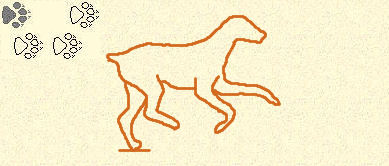
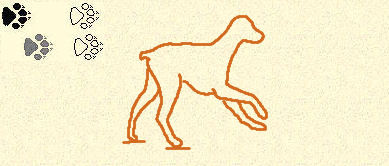
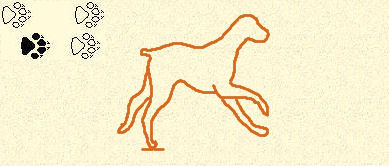
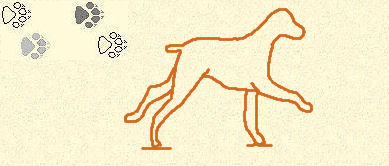
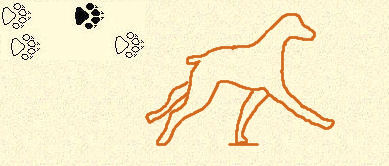
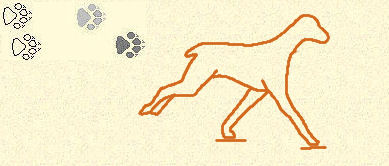
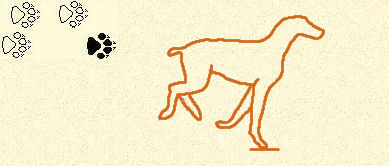
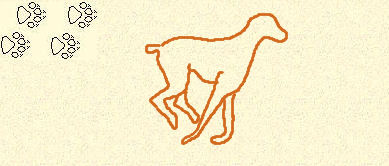
The gallop is a jumping, rocking, diagonal and asymmetrical gait with four (or three) beats.
It is the fastest gait and therefore the most important one for a field trial dog, which must cover the greatest possible distance in the shortest possible time. Since the gallop is an asymmetrical gait, we distinguish between a "right" gallop and a "left" gallop, depending on whether the right or left forelimb touches the ground first.
Three types of gallop can be distinguished:
Transverse gallop (right):
|
Rotatory gallop (right):
1st step: support from the right hindlimb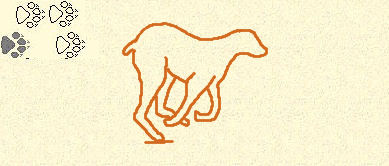
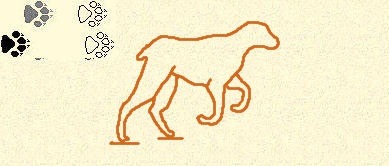 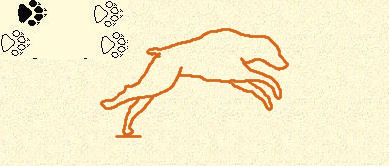 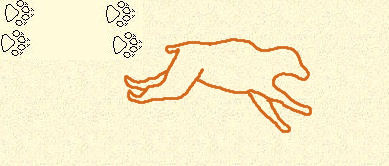 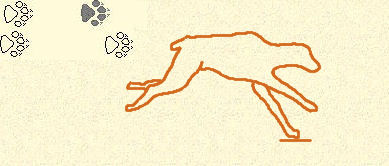 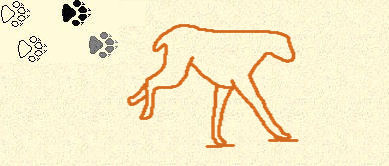 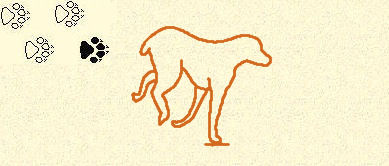 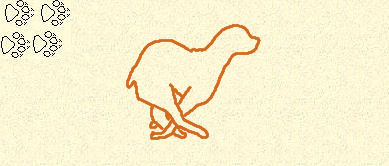
|
Here, we are concerned only with the rotatory gallop, the fastest type, which is used by field trial dogs.
I have often heard people comment on the galloping style of the Bourbonnais, interpreting certain characteristics of its stride as evidence of crossbreeding with other breeds.
There is probably some Brittany Spaniel ancestry in today's Bourbonnais. One only has to look at Rasteau/Pyrrhus
, whose genes are widespread throughout the Bourbonnais population today, to be convinced. There are also some English Pointer genes. After all, which continental breed does not have some Pointer ancestry?
However, trying to deduce a dog's origins from its galloping style is a real illusion. I am convinced that galloping style depends mainly on the dog's morphology.
Therefore, when Bourbonnais dogs are selected for a build similar to that of Brittany Spaniels, their gallop begins to resemble that of the Brittany.
Conversely, if dogs are selected for a build similar to that of English Pointers, their gallop will resemble that of the Pointer. There is no need for crossbreeding to achieve this.
It is therefore interesting to examine how morphological differences affect galloping style. The main differences to consider here are the length of the loin and the height of the rump.
It has a short loin and a slightly low-set rump.
Consequently, the leverage of the force generated by the hindlimbs is reduced. The thrust produced during the second and third steps is therefore weaker, and the dog remains airborne for a shorter time during the fourth step.
It lands on its forelimbs relatively early, and its low-set rump and short loin allow its hindlimbs to come forward again quickly, shortening the second suspension phase (the eighth step).
The result is a short, rapid stride characteristic of the Brittany's "rolling gallop" (also called the "pig gallop").
The advantage of these short strides is that they allow the dog to change direction quickly and require less energy, giving it greater endurance. The disadvantage is that this is not the fastest galloping style.
Here, the opposite is true. The morphology of this breed is partly inherited from its sighthound ancestors, resulting in a more aerial gallop.
The loin is long, allowing maximum thrust during the second and third steps. The dog can remain airborne for longer during the fourth step, as its high-set rump allows it to extend its hindlimbs as horizontally as possible.
When the forelimbs provide another thrust for the second suspension phase (the eighth step), this suspension must last long enough to allow the hindlimbs to return underneath the body.
The result is the long stride characteristic of the English Pointer's aerial gallop.
In terms of pure speed, this galloping style outperforms all the others. However, the long suspension phases make it difficult for the dog to make tight turns. Energy expenditure is also very high, and the dog has less endurance.
Not surprisingly, in my opinion, the Bourbonnais gallop lies somewhere between these two extremes. Its strides are less aerial than those of the English Pointer, but it is less fast than the Brittany. It should also be noted that the Bourbonnais is more heavily built than these two breeds. This has an impact on its gallop: it is slightly heavier and remains closer to the ground.
```