
Like all the French “braque” breeds, the Braque du Bourbonnais originated from the old Continental Braque, although, in terms of its origins and characteristics, it is the breed that differs most from it. Its ancestry is very old: it was already mentioned in 1580 in Bourbonnais (now the French department of Allier), in a facsimile of a work by Aldrovandi (a physician and naturalist from Bologna, 1522–1605, and the author of what was essentially a biological encyclopedia). It was described as a ticked dog with a short tail, skilled at hunting quail.
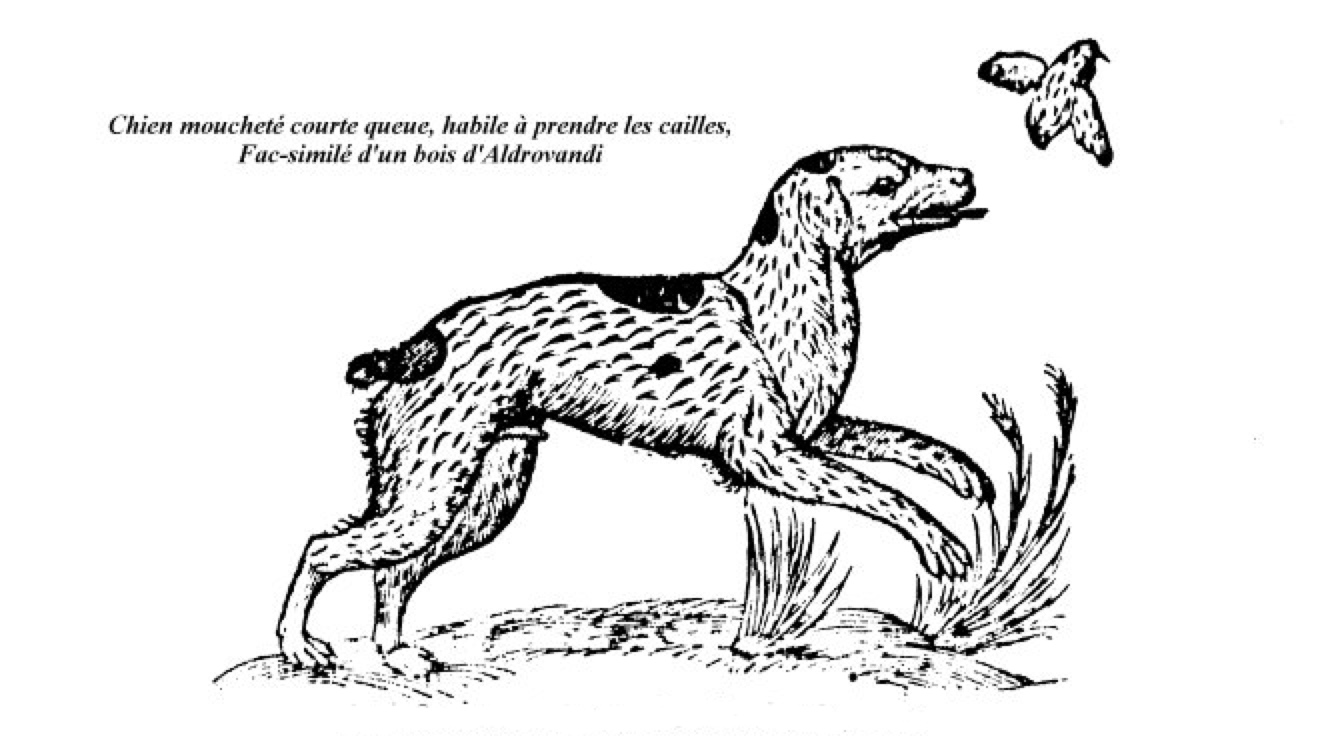
It is in the Allier department (the former province of Bourbonnais) that climate, terrain, game and hunters created a "small," rustic and sturdy pointer, giving an impression of robustness and strength, with a pear-shaped head and a very distinctive coat. It is distinctive because of the pattern of its markings, a homogeneous mixture of white and colored hairs. There are no large patches, but rather a liver-ticked or fawn-mottled coat that gives a kind of floury appearance, described as "average color," in shades ranging from fawn to light brown. This hue, for it is more a hue than a color, is easy to recognize by eye but very difficult to describe, so different authors have spoken of faded lilac, wine dregs, peach blossom and even "nymph's thigh." This last name apparently comes from an old variety of rose, white delicately tinted with pink.
The Braque du Bourbonnais was called the short-tailed braque because it is sometimes born without a tail (anury) or, more often, with a small tail of less than 15 cm (brachyury). For a long time this characteristic was used as a breed criterion; today it is a sign of descent from old lines. Our dog is as pleasant and biddable in the house as he is in the field; very attentive to commands, he shows great willingness to carry them out. Highly energetic, he is very attached to his master and forms a team with him. Gifted with an excellent nose and steady on point, he retrieves well and very often does so naturally. His gallop is powerful and sustained without flagging, and occasional stretches of trot allow him to adapt to the terrain. He quarters the ground methodically, without too much nervousness but with great dedication. He is a reliable hunting companion who can achieve good results in field trials open to all pointing breeds.